
Overall, I can see a lot of opportunity for researching keywords valuable to your business and implementing them across your website. The site structure could be reworked in order to really target specific terms on different pages, as opposed to one page featuring content about several different things.
For example, having a dedicated 'Ghost Writing' service page that only uses 'Ghost Writing' related key terms. This would help your individual pages to rank higher for specific terms, instead of one page competing for several keywords.
The performance of your website in organic search engines depends on many factors, both on your site and off of it. This report looks to highlight some of the key issues and opportunities in relation to your on site SEO. Often companies don’t realise how much can be gained by making sure the configuration of the website is done to best practices.
We’ve broken this report down into key sections about your website, detailing the areas that affect positions in search the most.
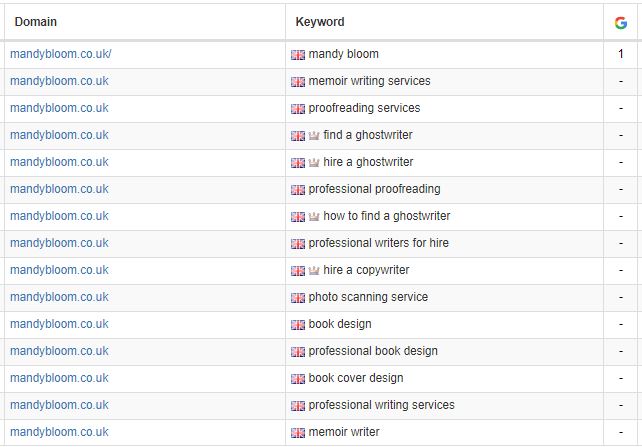
We’ve checked your positions in Google for some keywords that we think are relevant to your business. This isn’t an extensive list of terms, you may hold positions for other things, but it gives us a starting point for this report. Where the report has a dash (-) it means that the site is outside of the top 100 for that term.
One of the the most important onsite SEO elements, the Page Title should be keyword rich with the highest value keywords as close to the start as possible. It’s the blue text you see in search results, it also appears in your tabs at the top of your browser and is often the text used when sharing a page on social media. Every Page Title should be unique and make maximum use of the 50-60 character space available.

Headings are often thought of merely as styling for text on websites, while partly true, they also provide structure to the page for both Google and users. Each page should have a single h1 and then be broken down with h2s, h3s and so on.
Headings should be unique and include plenty of targetted keywords.
Paragraph text. Far far away, behind the word mountains, far from the countries Vokalia and Consonantia, there live the blind texts. Separated they live in Bookmarksgrove right at the coast of the Semantics, a large language ocean.
Paragraph text. A small river named Duden flows by their place and supplies it with the necessary regelialia. It is a paradisematic country, in which roasted parts of sentences fly into your mouth..
Paragraph text. Even the all-powerful Pointing has no control about the blind texts it is an almost unorthographic life One day however a small line of blind text by the name of Lorem Ipsum decided to leave for the far World of Grammar.
Paragraph text. The Big Oxmox advised her not to do so, because there were thousands of bad Commas, wild Question Marks and devious Semikoli, but the Little Blind Text didn’t listen. She packed her seven versalia, put her initial into the belt and made herself on the way.
Paragraph text. When she reached the first hills of the Italic Mountains, she had a last view back on the skyline of her hometown Bookmarksgrove, the headline of Alphabet Village and the subline of her own road, the Line Lane.
Including keywords in URLs (page addresses) helps both the user and Google understand what a page is about. It is always good to include keywords to maximise the opportunity.
Your URLs are great for explaining what the page is about, but they're not featuring high-value keywords for your website. URLs are one of the things Google considers when ranking your page in search engines, so there's an opportunity to rework this area to give you more SEO power.
How you link to pages within your website affects how search engines understand the site’s structure. Links should always have strong Anchor Text, meaning the wording used should clearly describe the page you are linking to. Click here, read more and alike are weak and give the user and search engines no context as to what the link refers to.
The anchor text you're using in your internal links are consistent, so great job at doing that. The main drawback observed is that the anchor text isn't particularly keyword orientated. For example, instead of linking to 'http://mandybloom.co.uk/services-prices' with the anchor text 'Services & Prices', it would be healthier to rework this to include your valuable key terms, such as 'Professional Writing Services Prices'. By doing this, you're helping Google to understand exactly what each page is about, and increasing your likelihood to rank for the keyword being linked.
Having links from other websites to yours will improve the positions you have in search engines. We are not going to go into too much detail about links in this report as we are focussing on the on-site elements, but we have checked to see how many you have.
Optimisation of images is often overlooked in respect to website SEO but it can play an important role. All images loaded to the site should have a good descriptive file name and include alt text, which helps search engines understand what the image is and also helps people with accessibility issues.
Currently, your image alt tags do not include the high value keywords you want to be targeting. It's important that images are optimised in this way because it tells Google exactly what they're all about. Better yet, your images may also appear in search results for users searching with those high-value terms.
The amount of written content you have on your website directly impacts the positions you hold in Google, the more content you have the more opportunity there is. Best practice is for each page to have 500-1000 words of optimised content.
Your on page content is great; you're not stuffing a page with irrelevant text, but you've got enough to give users all of the information they need. My recommendation for your content is to consider how it can split be up across multiple pages. For example, http://mandybloom.co.uk/services-prices/ has a lot of content about your different services, but in doing this, you're unable to really target specific keywords for each service.
If, for example 'Ghost Writing' had a separate page, you'll be able to optimise this page for SEO with Ghost Writing related key terms. How it currently stands, your pages are competing to rank for a variety of key terms/ services, which makes it difficult for Google to chose one over the other.
Google is now crawling websites in their mobile form, rather than desktop. What this means is that if your website doesn’t work well on mobile or hides content, you will be penalised in their results.
Your website is well optimised for mobile use, so well done for getting that right, this isn't often the case!
The speed that your website loads for users impacts both your positions in search and also the user experience. We are always aiming for websites to load within 2-6 seconds. There are occasions where slower is acceptable but if you want to keep people on the site this is by enlarge what you should be aiming for.
Having a secure site is vital for many reasons but especially so since modern web browsers point out to users when a site isn’t secure. All websites should have an SSL certification and sit on https rather than http.
Your website doesn't have a SSL certificate, which means that data being passed through your website isn't encrypted and secure. Google also penalises websites without a security certificate, and you can expect to rank lower because of this.

Congratulations - you made it! Welcome to our footer. If you made it this far you’ll know who we are and what we do, so it’s probably a good time for us to find out a bit about you. Get in touch, we’d love to hear from you.


